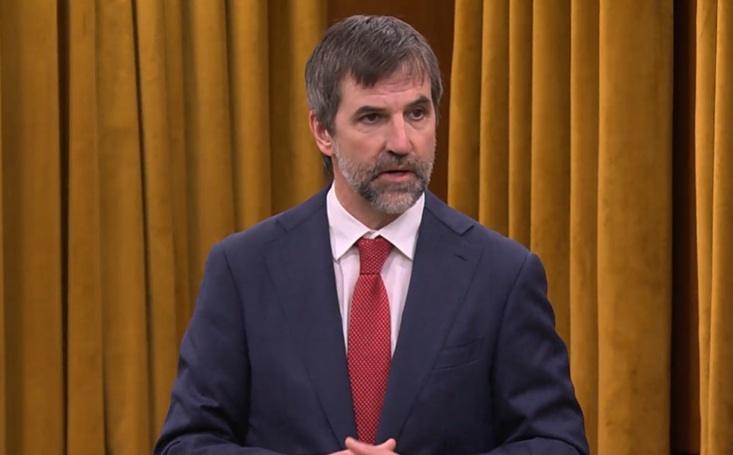
Canada’s Former Environment Minister Quits Over Climate Backtracking by Carney Government
Canadian Parliament member and former Minister of Environment and Climate Change Steven Guilbeault announced plans to resign from the government, citing Canada’s backtracking on its climate commitments under Prime Minister Mark Carney.
In a television interview following his announcement, Guilbeault said that the federal government’s recent deal with Alberta, Canada’s largest oil-producing province, enabling the construction of a new pipeline for oil exports to Asian markets, was a determining factor in his decision.
“If you look at our campaign platform during the last election, that platform – commitments that we made to Canadians – mentioned climate change 28 times. It did not mentions ‘pipeline’ once.”
The federal government signed an MoU with Alberta in November 2025, allowing future construction of an oil pipeline project, in exchange for environmental commitments from the province, including an increasing carbon price, methane emissions reductions, and a major carbon capture, utilization and storage (CCUS) project to support emissions reduction from oil production. Last month, the federal and provincial governments followed up the MoU with an agreement which may see the pipeline construction commence as soon as late 2027, and including a less onerous than expected increase in carbon prices through 2040.
The federal government signed an MoU with Alberta in November 2025, establishing a framework enabling federal support for a future oil pipeline project, in exchange for climate and emissions reduction commitments from the province, including an increasing industrial carbon price, methane emissions reductions, and a major carbon capture, utilization and storage (CCUS) project to support emissions reduction from oil production.
Last month, the federal and provincial governments followed up the MoU with an agreement which may see the pipeline construction commence as soon as late 2027, and including a less stringent carbon price trajectory than had previously been envisioned, with a more gradual increase through 2040.
In the interview, Guilbeault said that the new agreement will put Canada’s target to reduce emissions by 40% to 45% by 2030 well out of reach, saying:
“The Canadian Climate Institute… did an analysis… in 2024 showing that around 2030 we were going to be at -36% in terms of reducing pollution, our target was to get to at least to -40%, so we weren’t quite there, but we were getting closer. They did a similar analysis earlier this year before the signing of the MoU, saying right now we’ll be lucky if we’re at -18% to -21%…
“With the MoU, frankly, we’ll be lucky if we’re somewhere around -12%, -15% by 2030.”
Guilbeault has served as a member of parliament since 2019, and as Minister of Environment and Climate Change from 2021 to 2025. He stepped down from his cabinet position as Minister of Canadian Identity and Culture in November, following the initial MoU with Alberta.
Carney became Prime Minister in March 2025, with a strong resume in both finance and climate action, having served as the Governor of the both the Banks of Canada and of England, as the UN Special Envoy for Climate Action and Finance, as the UK Prime Minister’s Finance Adviser for the COP26 UN Climate Change Conference, and as co-Chair of the Glasgow Financial Alliance for Net Zero (GFANZ). Prior to running for Liberal leadership, he was serving as Chair and Head of Transition Investing at Brookfield Asset Management, focused on ESG investing.
In a post announcing his resignation, Guilbeault said:
“After almost seven years as a Member of Parliament and Minister, I have come to the conclusion that it is time for me to pursue my fight for environmental protection and the fight against climate change in a different way.”